Supporting Children & Teens with Body-Focused Repetitive Behaviors(BFRB)
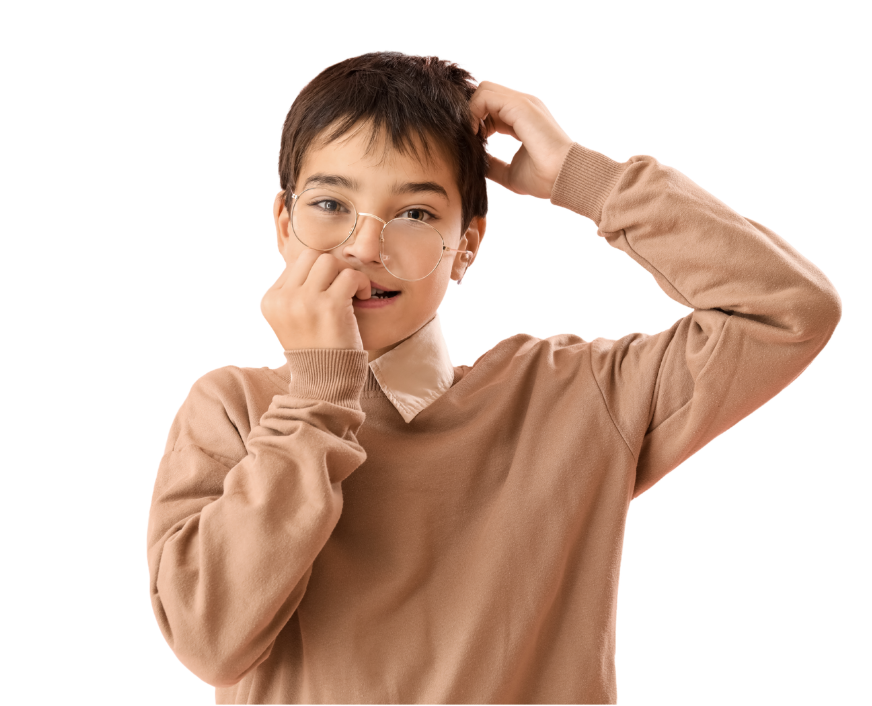
Body-Focused Repetitive Behaviors involve repetitive behaviors directed toward the body, such as pulling, picking, biting, or scraping. Common BFRBs include hair pulling, skin picking, nail biting, nail picking, and cheek or lip biting. For some kids and teens, these behaviors happen almost automatically. For others, there may be a strong urge, sensation, emotion, or feeling of tension that comes before the behavior.
At Raising Brave Kids, we help children and teens understand their BFRBs without shame while developing practical, evidence-based strategies to increase awareness, manage urges, and build greater control over their behavior.
Our goal isn't perfection. We want children to understand themselves better, learn skills that actually fit their lives, and feel increasingly confident in their ability to make different choices.
What Are Body-Focused Repetitive Behaviors?
Body-Focused Repetitive Behaviors, commonly called BFRBs, are repetitive self-grooming behaviors involving the hair, skin, nails, lips, cheeks, or other areas of the body. When these behaviors become repetitive and difficult to control, they can lead to physical damage as well as emotional distress.
Common BFRBs in children and teens include:
Hair pulling (Trichotillomania)
Skin picking (Excoriation or Skin-Picking Disorder)
Nail biting
Nail or cuticle picking
Cheek biting
Lip biting or picking
Skin biting
Hair biting or chewing
Other repetitive grooming behaviors that result in damage to the body
Not every child or teen who occasionally bites their nails or picks at a scab has a BFRB disorder. Many grooming behaviors happen from time to time.
We become more concerned when the behavior is frequent, difficult to control, causes physical damage or distress, or begins interfering with a child's confidence, relationships, activities, or daily life.
Some children & teens are very aware of their behavior and describe feeling a strong urge before pulling or picking. Others engage in BFRBs automatically while watching TV, doing homework, reading, riding in the car, using electronics, or lying in bed.
Many children & youth experience a combination of both.
Signs a BFRB May Need Additional Support
BFRBs can look different from one child or teen to another. Parents may notice:
Bald spots, thinning hair, or missing eyelashes or eyebrows
Repeated picking at acne, scabs, bumps, or healthy skin
Open sores, irritated skin, bleeding, or scarring
Nail or cuticle damage
Repeated biting of the lips or inside of the cheeks
Spending significant time pulling, picking, biting, or searching for a particular hair or area of skin
Trying repeatedly to stop without success
Hiding areas of the body with clothing, hats, makeup, hairstyles, or bandages
Avoiding swimming, sports, sleepovers, haircuts, or other activities because of embarrassment
Becoming upset when someone points out the behavior
Pulling or picking more during homework, screen time, boredom, stress, or bedtime
Shame, frustration, or embarrassment related to the behavior
Older children and teens may become especially skilled at hiding a BFRB. They may pull from less noticeable areas, dispose of hair privately, cover skin damage, or deny the behavior because they feel embarrassed.
This is one reason we approach BFRBs with curiosity rather than criticism.
BFRBs Aren't Simply a Matter of Willpower
One of the most important things we help families understand is that children with BFRBs aren't simply choosing not to stop.
A child may genuinely promise, "I'm never going to pull again," only to find themselves doing it an hour later.
That doesn't mean they aren't trying.
BFRBs can occur for many different reasons. A behavior might provide sensory stimulation, relief from tension, satisfaction, comfort, or something to do during periods of boredom or low stimulation. Sometimes a child or teen is very aware of the urge. Other times their hand seems to move toward their hair or skin before they consciously realize what's happening.
Because of this, repeatedly telling a child or teen to "stop picking" or "leave your hair alone" usually isn't enough to create lasting change.
In fact, increased attention, frustration, punishment, or shame can sometimes make things harder.
Effective treatment starts by asking a different question:
What is this behavior doing for this particular child or teen, and what skills or changes could help them respond differently?
A Personalized Approach to BFRB Treatment
No two BFRBs look exactly the same.
One teen may pull their eyelashes while reading because they enjoy finding a particular texture. Another may pick their skin when feeling stressed. A child might bite their nails without noticing during class, while another spends significant time in front of a mirror searching for skin imperfections.
That's why treatment at Raising Brave Kids is individualized.
We look at your child's:
Specific BFRB
When and where the behavior happens
Emotional triggers
Sensory triggers
Environmental triggers
Level of awareness
Motivation for change
Age and developmental stage
Family responses to the behavior
Other anxiety, attention, sensory, or emotional concerns
Rather than relying on one strategy, we help children and families develop a personalized toolkit.
A strategy that works beautifully during homework may not work at bedtime. A competing response that works for nail biting may be completely wrong for hair pulling.
Treatment is about becoming a detective together—understanding the patterns and finding strategies that fit.
Habit Reversal Training (HRT) for Kids and Teens
Habit Reversal Training, or HRT, is a behavioral treatment commonly used for BFRBs, including hair pulling and skin picking. It focuses on increasing awareness of the behavior and teaching an alternative response that makes the BFRB more difficult to perform.
HRT typically includes several important components.
Building Awareness
It's hard to change a behavior you don't notice.
Children learn to recognize when the behavior is happening, what their hands are doing, what sensations they notice, and what situations make the behavior more likely.
We might explore:
Where am I?
What am I doing?
What am I feeling?
What did my hand do right before I started?
Was I bored, worried, tired, frustrated, or concentrating?
Was there a specific sensation or texture I wanted to fix?
For younger children, we make this process concrete and engaging rather than turning it into another chore.
Recognizing Early Warning Signs
Over time, children learn to notice the moments that happen before pulling, picking, or biting.
Maybe their hand begins searching their scalp.
Maybe they start touching a scab.
Maybe their fingers move toward their mouth during homework.
Recognizing these early moments creates an opportunity to make a different choice before the behavior becomes automatic.
Using Competing Responses
A competing response is an action that makes it difficult to perform the BFRB at the same time.
The right competing response depends on the individual child and their behavior. Therapy helps children & teens experiment with options and determine what actually works in their everyday environment.
The goal isn't simply to keep their hands busy every second of the day. It's to strategically use alternative responses during high-risk moments and gradually strengthen the their ability to notice and respond to urges.
Using the Comprehensive Behavioral Model (ComB)
For many children, understanding the BFRB requires looking beyond the behavior itself.
The Comprehensive Behavioral Model, or ComB, helps us examine the different factors that may be contributing to pulling, picking, or biting. ComB and HRT are both CBT-based approaches used in the treatment of BFRBs.
We may explore areas such as:
Sensory factors: Does your child search for coarse hairs, uneven skin, scabs, bumps, or particular textures?
Cognitive factors: Are certain thoughts involved, such as needing an area to feel "smooth," "even," or "just right"?
Emotional factors: Does pulling or picking increase with anxiety, boredom, frustration, excitement, or fatigue?
Motor patterns: Does the child's hand automatically move toward their hair, face, or nails during certain activities?
Environmental factors: Is the BFRB more likely while watching television, using a tablet, sitting at a desk, being alone, or lying in bed?
Once we understand the child's particular pattern, we can develop targeted interventions instead of relying on generic advice.
Cognitive Behavioral Therapy (CBT)
Cognitive Behavioral Therapy helps children better understand the connections between their thoughts, emotions, urges, physical sensations, and behaviors.
For some children, unhelpful thoughts become part of the BFRB cycle.
A teen might notice an uneven bump and think:
"I can't leave it like that."
A child pulling hair may become focused on finding the "right" hair.
Another may become discouraged after pulling and think:
"I already messed up, so what's the point?"
CBT helps children develop more flexible ways of responding to these thoughts while building skills for managing frustration, anxiety, urges, and setbacks.
We also work hard to reduce all-or-nothing thinking around progress. One difficult day doesn't erase weeks of effort.
Acceptance and Commitment Therapy (ACT)
Sometimes trying desperately not to have an urge can make the urge feel even bigger.
Acceptance and Commitment Therapy, or ACT, helps children and teens practice noticing urges, thoughts, emotions, and uncomfortable sensations without automatically reacting to them. ACT is also used alongside other behavioral approaches in BFRB treatment.
We help children practice making choices based on what matters to them rather than what an urge is telling them to do in that moment.
For a teen, that might mean working toward feeling comfortable wearing their hair down again.
For another child, it might mean participating in swimming without worrying about hiding picked skin.
The goal isn't to never experience an urge again. It's to build greater flexibility in how a child responds when urges show up.
Building Motivation Without Shame
Kids and teens don't always arrive at therapy motivated to change their BFRB.
Sometimes parents are far more concerned about the behavior than the child is. Other children desperately want to stop but have become discouraged after trying unsuccessfully again and again.
Both are common.
We don't believe shame, punishment, criticism, or constant reminders create meaningful change. Children with trichotillomania may already experience significant embarrassment or guilt, and AACAP specifically cautions that punishment is unlikely to reduce hair pulling and may negatively affect self-esteem.
Instead, our therapists work to understand what matters to the child.
Maybe they want their eyebrows to grow back. Maybe they want to stop hiding their hands. Maybe they want fewer arguments with their parents. Or maybe their initial goal is simply understanding why the behavior happens.
We start there.
Motivation can grow as children begin experiencing success and develop a stronger sense of control.
Working Closely With Parents and Families
Parents play an important role in BFRB treatment, particularly with younger children.
One of the hardest things for parents is knowing what to say when they see the behavior happening.
Should you remind them?
Ignore it?
Take away privileges?
Tell them to stop?
The answer depends on the child, but repeated correction and criticism rarely help.
We work with families to create a response plan that supports awareness and skill-building without creating shame.
Parent coaching may include:
Learning more about how BFRBs work
Recognizing triggers and high-risk situations
Helping implement strategies at home
Creating environmental supports
Using agreed-upon cues or reminders
Reinforcing effort rather than perfection
Supporting motivation
Reducing criticism and conflict around the behavior
Knowing when to step in—and when to step back
When children experience their family as part of their support team rather than the "BFRB police," treatment tends to feel much more collaborative.
Supporting BFRBs at School
BFRBs don't only happen at home.
Children & teens may pull, pick, or bite more frequently during tests, independent work, reading, computer activities, long lectures, or other situations involving stress or sustained attention.
Some children & teens also become self-conscious when peers notice their hair, skin, or behaviors.
When appropriate, and with parent permission, our therapists can collaborate with teachers, school counselors, and other school staff to help create practical supports.
This might include discreet access to a competing-response tool, environmental modifications, a private signal between a student and teacher, or helping adults understand why calling attention to the behavior publicly is usually not helpful.
Educators can play an important role in creating a supportive school experience for students with BFRBs.
Frequently Asked Questions About BFRBs
Is a BFRB the same thing as OCD?
BFRBs and OCD can share some features, but they are not the same thing.
OCD typically involves obsessions—intrusive thoughts, images, or urges—and compulsions performed to reduce distress or prevent a feared outcome.
BFRBs are often driven more by urges, sensory experiences, automatic habits, emotional regulation, or feelings of satisfaction or relief.
Some children & teens can experience both OCD and a BFRB, which is one reason careful assessment matters.
Is hair pulling always Trichotillomania?
No. Children may occasionally play with or pull their hair without meeting criteria for Trichotillomania.
We consider factors such as frequency, hair loss, attempts to stop, distress, and how much the behavior interferes with everyday life.
Is skin picking always Excoriation Disorder?
No. Most people pick at their skin occasionally.
Skin picking becomes more clinically concerning when it is repetitive, difficult to control, causes skin damage, and creates significant distress or impairment.
What if my child or teen doesn't notice they're doing it?
This is very common.
Some BFRBs are highly automatic. Building awareness is often one of the first steps in treatment. We help children & teens notice patterns without making them feel watched or criticized all day.
Should I tell my child or teen to stop when I see them pulling or picking?
Constant reminders can quickly become frustrating for both children and parents.
Instead, we often help families develop an agreed-upon system for prompting or cueing that feels supportive rather than critical. The right approach depends on the child's age, awareness, motivation, and treatment goals.
What if my child or teen doesn't want to stop?
That's okay.
Treatment doesn't have to begin with a child committing to completely stop the behavior.
Our therapists are skilled at working with motivation. We may initially focus on helping the child understand the behavior, identifying what they would like to change, and building small successes that increase their sense of control.
Can stress make a BFRB worse?
It can, but stress isn't the only trigger.
Some children pull or pick more when anxious or upset, while others do it when relaxed, bored, tired, concentrating, or under stimulated. Understanding each child's specific pattern is an important part of effective treatment.
How long does BFRB treatment take?
Treatment length varies depending on the behavior, its severity, how long it has been occurring, the child's awareness and motivation, and other factors that may be contributing.
We regularly review progress with families and adjust treatment strategies as children develop new skills.
Helping Your Child Better Understand and Manage Their BFRB
Watching a child or teen pull their hair, pick their skin, or repeatedly engage in another BFRB often leave parents feeling worried, frustrated, and unsure how to help.
You don't need to solve it by simply reminding them to stop.
With the right support, children and teens can learn to understand their patterns, recognize urges earlier, experiment with new responses, and develop greater confidence in their ability to manage their behavior.
At Raising Brave Kids, we approach BFRBs with curiosity, compassion, and practical evidence-based strategies—without shame or blame.
If your child or teen is struggling with hair pulling, skin picking, nail biting, nail picking, or another Body-Focused Repetitive Behavior, we're here to help.
Contact us today or schedule a free 15 min consultation
Child & Teen Anxiety Therapy | OCD | Social Anxiety | Parent Coaching | Our Therapists
Maybe you've noticed your child repeatedly pulling their hair, picking at their skin, biting their nails, picking at their cuticles, or biting the inside of their cheeks. They may tell you they don't even realize they're doing it—or they may desperately want to stop but find themselves returning to the behavior again and again.
For parents, Body-Focused Repetitive Behaviors (BFRBs) can be confusing. It can look like a habit that a child should simply be able to stop, especially when the behavior is causing hair loss, irritated skin, bleeding, scarring, or embarrassment.
But BFRBs are much more complicated than a "bad habit."